

Hawaiki Mokopuna represents a time and space where whānau are healthy, strong, and empowered to fulfil their dreams and aspirations, where te reo Māori is safe and intergenerational transmission is uninterrupted. The health of te reo Māori is inherently connected to the health of te ao Māori, of whānau Māori. 

It represents a future where our Tamariki and mokopuna embody mana motuhake as they lead sustainable lives connected to their communities and a strong sense of identity. By championing the Māori language as an important component of individual and whānau wellbeing we will create healthy and thriving communities, making our way closer to Hawaiki Mokopuna.

Planning our Journey

Arriving at Hawaiki Mokopuna by 2040 requires a focused and well-organised approach. Since our last Statement of Intent (2021-2024), we have shifted from five broad focus areas to two key priorities: Tukuihotanga, which emphasises deliberate intergenerational transmission, and Hononga Hapori Reo, which focuses on building connected language speaker communities. This strategic realignment allows Te Mātāwai to ensure our outputs are aligned with the long-term goals of Maihi Māori.

Over the coming years, we will have regular checkpoints along our journey to evaluate our progress and adjust our course as necessary. Our first destination is Hawaiki Tipuna, and this phase of our voyage will extend from now until 2027.

As we travel closer to Hawaiki Mokopuna, our priorities are likely to change as we look to new constellations for navigation. While not a primary focus for navigation, understanding the signs of well-being and ill-being with te reo Māori is an essential task for Te Mātāwai and the Crown moving forward. 

Our operational model includes an outcomes framework that outlines the priorities and roles of our partners in supporting kāinga, hapori, and iwi. We use the Hawaiki Mokopuna navigational metaphor to draw confidence from our skills and experiences, preparing us for the journey ahead.

Setting sail to Hawaiki Tipuna 2027

We have navigated Crown and Government systems and established a platform to give Māori more authority and responsibility since our creation in 2016. Hawaiki Tipuna provides the first opportunity for Te Mātāwai to take stock of a more holistic viewpoint that incorporates kāinga, hapori, and iwi; a Māori worldview; and a national view as a Crown partner.

It is at destination Hawaiki Tipuna that Te Mātāwai will identify the foundational priorities to adopt and entrench through to 2040 as ‘the’ proven model to achieve uninterrupted intergenerational transmission of te reo Māori and improved whānau wellbeing.
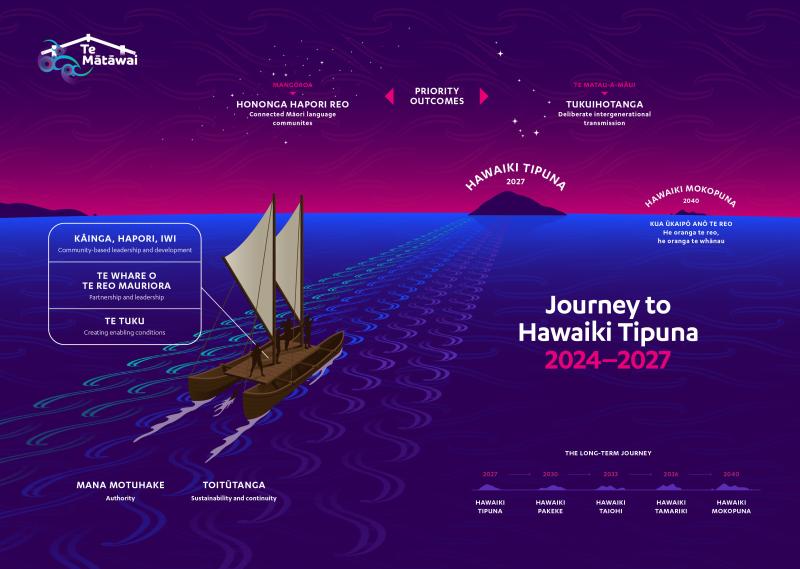
Journey from Hawaiki Tū 2024 to Hawaiki Tipuna 2027

Over the past seven years, kāinga, hapori, and iwi have received support through direct investment from Te Mātāwai. Moving forward, we will continue to engage with the Crown regarding their role in resourcing our communities, while fulfilling our respective responsibilities under Te Whare o te Reo Mauriora. Te Mātāwai is dedicated to leading discussions that will clarify and embed the principles of engagement necessary to optimise this partnership model. Our services to kāinga, hapori, and iwi, as well as our work with Te Whare o te Reo Mauriora, will continue to be guided by Te Tuku (our operational arm) as we strive to future-proof our capability, capacity, and succession across our organisation and communities.

Future Focused Priorities – Tukuihotanga and Hononga Hapori Reo

Prioritising Tukuihotanga (language use within whānau between parents and children) alongside Hononga Hapori Reo (connected Māori language communities) demonstrates the clear intent of Te Mātāwai to ensure the use of te reo Māori between generations occurs and that connectivity among users is maintained. These keypriorities are critical to sustainable outcomes.

Tukuihotanga Intergenerational Transmission

Focusing on intergenerational transmission is essential to ensure that today’s children become confident speakers of the Māori language in the future. Previous methods for allocating resources assumed that increased Māori language activities would result in greater language use among adults and children. While some measurable micro-shifts support this assumption, it is now time for Te Mātāwai to adjust our approach to achieving intergenerational transmission. We will continue to allocate resources and invest in initiatives that show measurable impacts towards our goal of having 25% of children under seven speaking Māori as their first language by 2040.

Hononga Hapori Reo Connected Māori language communities

Connecting Māori language speaker groups will contribute to the second goal of the Maihi Māori – to have one million people or more using te reo Māori in community immersion domains by 2040. Having invested in legacy groups and communities (kāinga, hapori, and iwi) over seven years, Te Mātāwai has helped to develop a firm foundation that provides opportunities for reo use across diverse spaces. By prioritising the connection of these communities, we aim to expand opportunities for using te reo, while also nurturing networks of support for the ongoing growth of these te reo-speaking communities.